
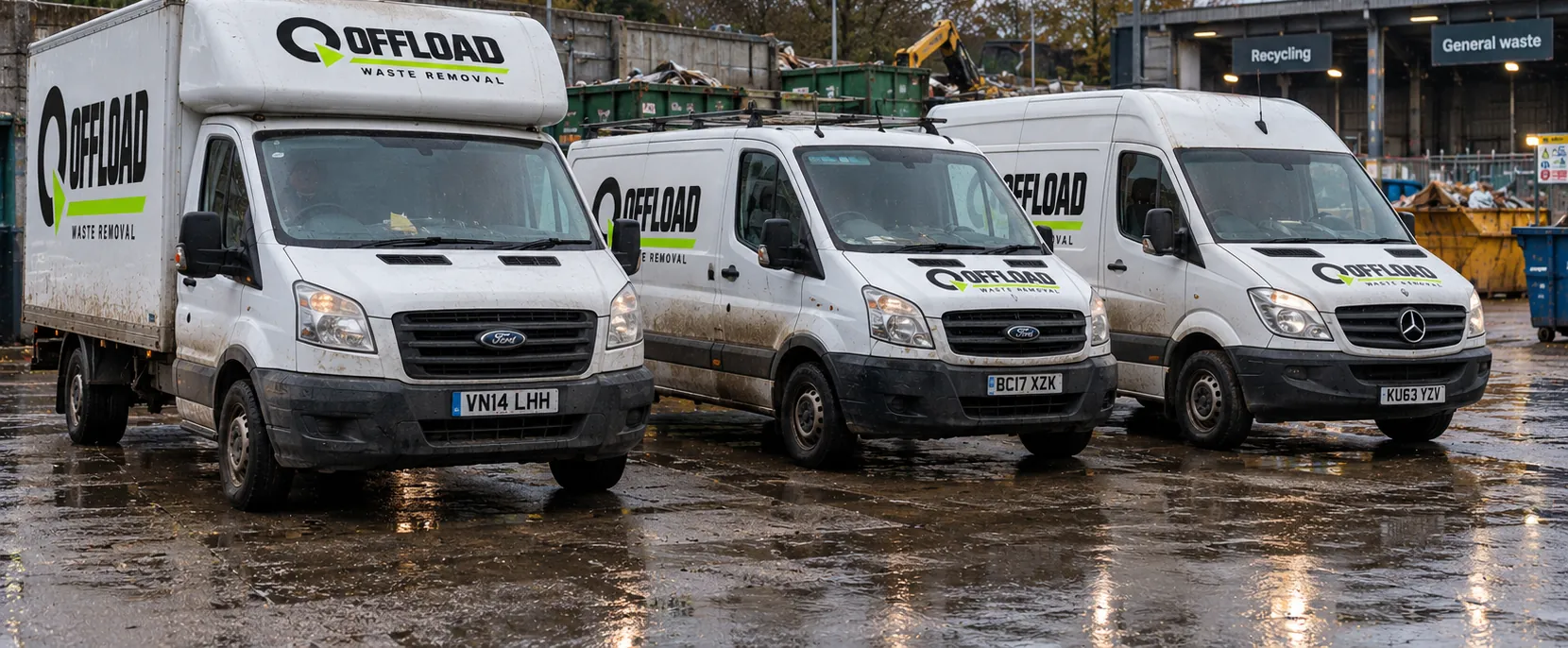
The order of preference: the waste hierarchy
UK waste policy follows a ladder known as the waste hierarchy. The idea is simple. The best outcome is not producing the waste at all. After that, the order of preference runs from reuse, to recycling, to recovering value from what is left, and finally to disposal.
A good collection tries to work down that ladder rather than jump straight to the bottom. A sound wardrobe or table might still have a life elsewhere. Timber, metal and cardboard can usually be recycled. Material that cannot be reused or recycled may be used to recover energy. Only what is left over should be sent for disposal. Not every item can climb the ladder, and a crew will not always know in advance how far a particular piece will go, but that is the direction of travel.
Sorting comes first
Waste is rarely sent onward exactly as it was loaded. A mixed van load usually needs sorting at a suitable site so that different materials can be separated. Wood, metal, plastics, paper and card, soft furnishings and general residual waste tend to go different ways.
Sorting is also where mistakes get caught. Items that need separate handling, such as electrical goods, batteries or anything containing hazardous substances, have to be picked out so they do not end up in the wrong stream. That is one reason we ask about unusual items before we arrive. It is far easier to plan a route for something specific than to find it at the bottom of a mixed pile.
Why permitted sites matter
Waste in England can only lawfully be received and treated at sites that hold the right permit or exemption for that type of waste. The permit is there to control what a site can take and how it must manage it, so that waste is not simply dumped or stored unsafely.
A carrier does not get to choose any convenient spot. Waste has to go to a site that is authorised for it. This is one of the biggest differences between a properly run waste removal Leeds service and someone who takes your rubbish for cash and no questions. If the load is dumped in a lay-by or a field, it is your waste that is being fly-tipped, and enforcement can start with the householder if the trail leads back to you.
The waste transfer note is your proof
When you pass household waste to a carrier, you should receive a waste transfer note or an equivalent record. It is a short document, but it does real work. It shows who took the waste, what it was, when it was taken and that the carrier is registered.
Keeping it protects you. If waste from your address is ever found somewhere it should not be, the note is how you show you did the responsible thing. Ask for one every time, whoever you use, and keep it with your household papers for a sensible period. At Offload we provide a transfer note with each job, and a genuine carrier should be happy to do the same.
- Who collected the waste, and their carrier registration details
- A description of what was taken
- The date of collection
- Where the waste came from
How to check a carrier before you book
You do not need to be an expert to do a basic check. A few questions will tell you a lot about how a business handles waste after it leaves your property.
Ask for their waste carrier registration
Carriers of waste in England are expected to be registered with the Environment Agency, and you can usually check the public register online.
Ask where the waste goes
A straight answer about permitted sites is a good sign. A vague one is not.
Ask for a transfer note
If they say you do not need one, be wary.
Watch out for very low cash offers
A price that seems too small to cover a legal disposal often is.
What you can do to help the process along
You have more influence than you might think. If you separate out anything obviously hazardous, and tell the crew about it, they can plan for it. If items are still usable, say so. Some things can be passed on before collection, and that keeps them higher on the hierarchy.
Keep the paperwork, keep the route clear and be honest about what is in the pile. That is really all it takes for your waste to follow the path it should.
Your paperwork is part of the jobA waste transfer note shows who took your waste and confirms it went through a registered carrier. Ask for it every time and keep it somewhere safe.
Questions
Does everything I hand over get recycled?
No. Some material can be reused or recycled, some is used to recover energy and some has to be disposed of. What happens to each item depends on what it is, its condition and what the receiving site can accept.
Do I really need a waste transfer note for household rubbish?
You should always ask for one. It records who took your waste and is your evidence that it was passed to a registered carrier.
Can I find out exactly where my waste went?
You can ask the carrier which type of permitted site they use. They may not be able to name a single site for every load, but they should be able to explain the route in general terms.
What if something is found fly-tipped and traced to me?
Householders have a duty of care to check who they hand waste to. Using a registered carrier and keeping your transfer note is the best protection.
Services that help
Rubbish removal
Rooms, lofts, garages and one-off loads taken away.
See the serviceHouse clearance
Probate, void and downsizing clearances, room by room.
See the serviceBulky waste
Sofas, beds, wardrobes and large items taken from anywhere in the house.
See the serviceLocal pages
- Waste removal in HeadingleyLS6
- Waste removal in KirkstallLS4, LS5
- Waste removal in Leeds city centreLS1, LS2
More guides
- How a van waste removal quote is built in Leeds
- Using Leeds household waste recycling sites: who they suit
- Council bulky collection or private waste removal in Leeds?
- How to get rid of a sofa in Leeds
- Clearing a house after a death: a gentle practical guide
- End of tenancy clearance checklist for tenants and landlords
- Waste transfer notes and your duty of care
- What cannot go in a skip in Leeds, and why
- How to check a waste carrier is registered in Leeds
- Fly-tipping and your duty of care as a householder in Leeds
- Student move out rubbish in Leeds: a guide for tenants and landlords
- How to prepare for a house clearance in Leeds
- Clearing a loft safely: a practical guide for Leeds homes
- Clearing a flat in Leeds city centre: lifts, loading bays and timing
- Donate, sell or dispose of old furniture in Leeds
- How much waste fits in a van load: a Leeds guide
- Clearing your home before you sell in Leeds
- Garden waste in Leeds: what to do with it
- Clearing a hoarded home with respect in Leeds
- Old sofas and flame retardant rules: what Leeds households should know