
Know what you are standing on
In most lofts the floor is not a floor. The only strong parts are the joists, the timber beams that run across the house. Between them is usually plasterboard or plaster, the ceiling of the room below, and it will not carry your weight. Step on it and you can go through.
Many lofts have some loose boards laid across the joists for storage, and these can be patchy. Test each one before you trust it. If you need to go beyond the boarded area, lay a sturdy board across two or three joists and keep your weight on that, moving one step at a time.
Set up before you go up
A bit of preparation prevents most accidents. The loft hatch is also often narrow and awkward, so think about what has to pass through it.
- Wear long sleeves, gloves, sturdy shoes and a dust mask
- Use a head torch so both hands stay available, and add a work light if you can
- Have a stable ladder that reaches well past the hatch, with someone to steady it
- Keep a second person on the landing to pass things and to notice if something goes wrong
- Take your phone with you, and tell someone else in the house that you are going up
- Clear the landing below so there is somewhere to put things down
Insulation, dust and heat
Loft insulation is usually laid between and over the joists. It can irritate skin, eyes and lungs, so cover up and avoid squashing it more than you need to. Flattened insulation does not work as well, so try not to trample it.
Lofts get hot in summer and cold in winter, and the air can be dusty. Take breaks, drink water and stop if you feel unwell. Avoid cramped spaces if you have heart, breathing or balance problems, and ask someone else to do it instead.
Weight, ladders and getting things down
The most common injuries come from carrying awkward loads down a ladder. Do not carry a heavy box while climbing. Pass things to the person on the landing in stages, one item at a time, and keep at least one hand on the ladder.
For heavy or bulky things, such as old suitcases full of books, a trunk or a water tank, stop and think whether it is safe to move them at all. Some items are best broken down in the loft first. Some jobs need a second and third pair of hands.
Check the hatch and ladder
Make sure the ladder is stable and reaches at least a metre above the opening.
Bring items to the hatch
Slide or carry them along boards, not across bare plasterboard.
Lower in stages
Hand items down one at a time to someone standing safely.
Bag loose material
Use strong bags for small items and keep them light enough to lift easily.
Asbestos awareness
Some older buildings contain asbestos in places you might not expect: textured coatings, insulation board, pipe lagging, old water tank covers and some loose fill insulation. You cannot tell by looking. If you see material that might be asbestos, do not touch, drill, sand, break or sweep it.
Come down, close the hatch and get advice. Check the Health and Safety Executive guidance on gov.uk and speak to a licensed asbestos specialist about testing. Do not put suspect material in your bags or ask a clearance crew to take it before it has been identified. It needs specialist handling and cannot be treated as ordinary rubbish.
When not to go up, and how we can help
Leave the loft alone if the hatch is too small to use safely, the boards are rotten or missing, you see signs of water damage, there is wiring you cannot avoid, or you have any doubt about the material. A loft that is full to the eaves with no clear path is also better handled by people who do it regularly.
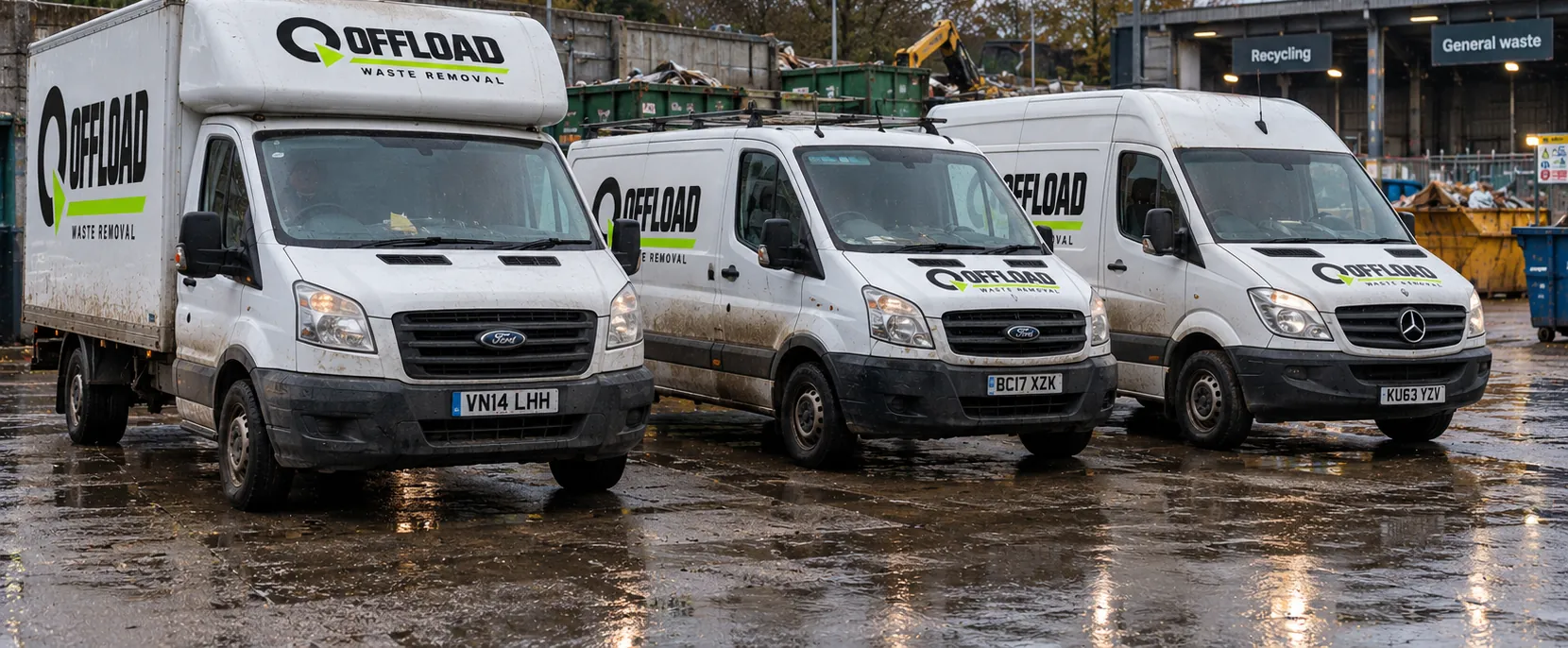
If you would rather someone else took it on, Offload waste removal Leeds can look at photos of the hatch, the ladder route and the pile, and tell you whether it is something we can do. Mention any items on the regulated list, and anything you are unsure about.
Never disturb suspect materialIf something in the loft might be asbestos, stop, leave it as it is and get specialist advice. No clearance is worth breathing it in.
Questions
Can I stand on the ceiling between the joists?
No. The ceiling is usually plasterboard and it will not take your weight. Stay on the joists or on boards laid across them.
How do I know if something contains asbestos?
You cannot tell by eye. If it looks suspect, leave it alone and ask a licensed specialist to test it. Check the HSE guidance on gov.uk.
Should I remove old insulation?
Not as part of a clear out, unless you have a reason and know what it is. Ask a qualified installer for advice first.
Do I need to take everything out at once?
No. It is safer to work in stages, bringing items down in small loads, than to try to do it all in one go.
Services that help
House clearance
Probate, void and downsizing clearances, room by room.
See the serviceRubbish removal
Rooms, lofts, garages and one-off loads taken away.
See the serviceMan and van
A wait and load alternative to skip hire, with a licensed carrier.
See the serviceLocal pages
More guides
- How a van waste removal quote is built in Leeds
- Using Leeds household waste recycling sites: who they suit
- Council bulky collection or private waste removal in Leeds?
- How to get rid of a sofa in Leeds
- Clearing a house after a death: a gentle practical guide
- End of tenancy clearance checklist for tenants and landlords
- Waste transfer notes and your duty of care
- What cannot go in a skip in Leeds, and why
- How to check a waste carrier is registered in Leeds
- Fly-tipping and your duty of care as a householder in Leeds
- Student move out rubbish in Leeds: a guide for tenants and landlords
- How to prepare for a house clearance in Leeds
- Clearing a flat in Leeds city centre: lifts, loading bays and timing
- Donate, sell or dispose of old furniture in Leeds
- What happens to your waste after a Leeds collection
- How much waste fits in a van load: a Leeds guide
- Clearing your home before you sell in Leeds
- Garden waste in Leeds: what to do with it
- Clearing a hoarded home with respect in Leeds
- Old sofas and flame retardant rules: what Leeds households should know