
Why the check matters to you
Householders have a legal duty of care for the waste that leaves their property. In plain terms, you must take reasonable steps to make sure your rubbish is handed to someone authorised to take it, and that it ends up somewhere legal. Paying somebody to take it does not end your responsibility on its own.
If a carrier dumps your load in a lane or a field and it is traced back to you, you can be asked to explain what checks you made. Checking the register beforehand, and keeping a record that you did, is the simplest way to show you acted reasonably.
How to use the public register
The Environment Agency keeps a public register of registered waste carriers, brokers and dealers in England. It is on the gov.uk website, and searching for it as check if a waste carrier, broker or dealer is registered will find the current page. Anyone can use it, so there is no reason to skip it.
Ask for the registration number
A genuine carrier can give it to you straight away. In England it usually starts with the letters CB.
Search the register
Enter the number, or search by the carrier's name and postcode, on the gov.uk register page.
Match the details
Check that the name on the register matches the name on the quote, the van and the paperwork.
Check the status
Look for a current registration that has not expired or been revoked.
Keep a note
Screenshot the result or write down the date you checked. It takes seconds and it is useful later.
Questions to ask before you book
A short conversation tells you a lot. A registered carrier used to householders asking these questions will answer them without fuss. If someone gets awkward or vague, treat that as information.
- What is your waste carrier registration number?
- Where will the waste be taken?
- Will I get a waste transfer note or a receipt for the job?
- What is the business name and is there an address or landline I can check?
- Do you need photos, or to see the waste, before you give me a quote?
- Are there items you will not take, and what happens to those?
Red flags that should make you stop
No single sign proves a carrier is dodgy, but several together are a clear reason to walk away. The most common ones are simple to spot once you know them.
- Cash only, with no invoice, no receipt and no paperwork
- No registration number on the advert, the website or the vehicle
- A number that will not come up on the register, or is under a different name
- A vague answer about where the waste goes, or a refusal to say
- A price quoted on the doorstep only after seeing the load, with pressure to agree at once
- An advert with a mobile number and nothing else, no name and no location
- Unmarked vehicles with loose loads and nothing covering them
The paperwork you should get
After the job you should receive a waste transfer note. It describes the waste, says roughly how much there was, records the date and names both you and the carrier. Keep it. There is no exact period set out for householders, so a sensible approach is to hold on to it for at least a couple of years, and longer for a large or unusual clearance.
If you are a landlord, an agent or a business, your waste is treated as commercial waste and your record keeping obligations are stricter. Check gov.uk for the current requirements or ask your carrier what they supply.
What we do at Offload
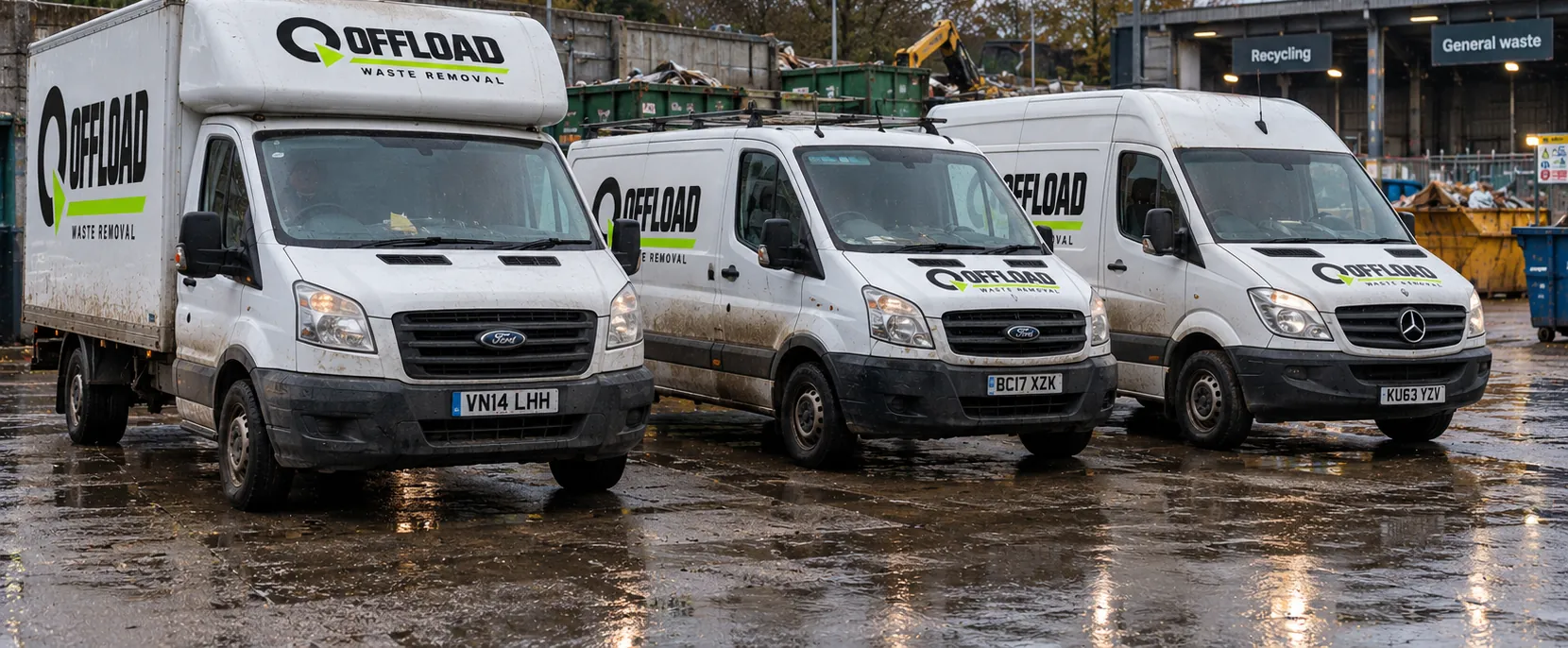
If you book Offload waste removal Leeds, we are happy for you to ask for our details and check the register yourself, and you receive a waste transfer note for each job. Whoever you choose, the same checks apply. A good carrier will never mind being asked.
Two minutes now saves a lot laterAsk for the registration number, look it up on the Environment Agency register and keep a note of the date. If the carrier will not give you a number, that is your answer.
Questions
Is a registration number the same as a licence?
In everyday talk people use the words together. Carriers are registered with the Environment Agency and given a registration number, and that is what you look up on the public register.
Do I need to check a carrier who is recommended by a neighbour?
Yes. A recommendation is helpful but it does not replace the check. The register only takes a couple of minutes and covers you if something goes wrong.
Can I be responsible if the carrier fly-tips my rubbish?
Your duty of care means you should take reasonable steps to pass waste to an authorised person. If you checked the register and kept your paperwork, you are in a much stronger position.
What if the carrier is registered but I am still unsure?
Trust that instinct. Ask for the transfer note in writing, ask where the waste is going and get a second quote if you need to.
Services that help
Rubbish removal
Rooms, lofts, garages and one-off loads taken away.
See the serviceHouse clearance
Probate, void and downsizing clearances, room by room.
See the serviceMan and van
A wait and load alternative to skip hire, with a licensed carrier.
See the serviceLocal pages
More guides
- How a van waste removal quote is built in Leeds
- Using Leeds household waste recycling sites: who they suit
- Council bulky collection or private waste removal in Leeds?
- How to get rid of a sofa in Leeds
- Clearing a house after a death: a gentle practical guide
- End of tenancy clearance checklist for tenants and landlords
- Waste transfer notes and your duty of care
- What cannot go in a skip in Leeds, and why
- Fly-tipping and your duty of care as a householder in Leeds
- Student move out rubbish in Leeds: a guide for tenants and landlords
- How to prepare for a house clearance in Leeds
- Clearing a loft safely: a practical guide for Leeds homes
- Clearing a flat in Leeds city centre: lifts, loading bays and timing
- Donate, sell or dispose of old furniture in Leeds
- What happens to your waste after a Leeds collection
- How much waste fits in a van load: a Leeds guide
- Clearing your home before you sell in Leeds
- Garden waste in Leeds: what to do with it
- Clearing a hoarded home with respect in Leeds
- Old sofas and flame retardant rules: what Leeds households should know